Some martial arts teachers are very proud of their lineages; they, or their teachers, may have learned from a noted practitioner, or better yet, from a lesser-known, “secret” lineage.
Of the Yang style, the Yang Chengfu Large Frame is the most popular. From the earlier Yang elders, there are the Small Frame (Yang Banhou and Yang Shaohou), the Middle Frame (Yang Jianhou), and the Application Form and Fast Form (Yang Banhou and Yang Shaohou). Wu Tunan also claimed to have learned his Fast Form from Yang Shaohou, but it generally does not resemble the Yang Shaohou Fast Form practiced by other disciples.
Students and contemporaries of Yang Chengfu also developed or continued earlier styles, such as Cheng Man-ch’ing (37 Short Form, Middle Frame) and the Dong/Tung family, who also developed their own Fast Form. Yang Chengfu’s son, Yang Shouzhong, also passed on his own derivative forms. Other notable figures from the early 1900s include Tian Zhaolin 田兆麟, Chen Weiming 陳微明, Niu Chunming 牛春明, and many others who learned from the second and third generations of the Yang Family.
In addition, there is the Guang Ping Form, from Yang Luchan’s home village, and various lesser-known teachings such as the Imperial Form. Most teachers also modify their teachings based on their own understanding and preferences.
Keep in mind that forms and knowledge do not necessarily pass through direct teacher-student relationships. Masters sometimes exchanged skills, so it is common for a master in one discipline to have obtained high-level skill in other martial arts. Hence there are masters who excelled in multiple internal martial arts, such as Xingyi, Bagua, and Tai Chi.
Some of the most controversial lineages come from the Fast Form and Middle Frame practitioners. Somehow the Fast Form is sometimes held up as the gold standard for Yang Tai Chi, and the Middle Frame is likewise prized for its rarity. None of these lineages actually guarantee real skill in the practitioner. Meanwhile, although the Yang Chengfu form is the most popular, it is often deemed “less martial” than the older forms.
In the end, finding a good teacher and being a good student matters most.
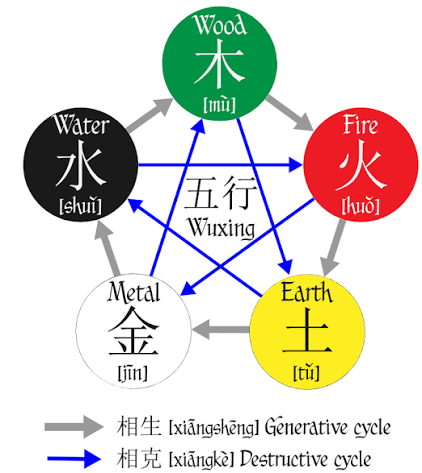
The Chinese five elements are the basis for the transformations of mutual generating and overcoming, the process of which is the source of all things. The common description of the five elements theory is that in the constructive cycle: metal generates water, water generates wood, wood generates fire, fire generates earth, and earth generates metal. In the “destructive” / controlling cycle: metal overcomes wood, wood overcomes earth, earth overcomes water, water overcomes fire, and fire overcomes metal.
As applying to martial arts, Xingyi explicitly maps the “five fists” into each element, although which came first, the creation of the fists based on the elements or a later adaptation of the elements into the existing martial arts, is not clear and lost in time.
In Tai Chi, there is “Eight Gates and Five Steps” but the five steps is typically not associated with the Five Elements per se even though the Chinese words are the same.
In Yiquan, it is said that 五行合一, or “Five Elements Harmonize as One”: the main skeletal structures and sinew are Metal, providing the core of unyielding hardness. The joints and smaller bones are like the trees and Wood, bending and extending. The whole body moves like a dragon, with the power and character of Water, moving unexpectedly yet with grace. When striking and Fajin, the jin shoots out the hands like an arrow leaving the bow, with the power of Fire. Finally, the entire body, filling with Qi, expressed as Peng Jin, this is the power of Earth.
With every action, always have these five kinds of strength. This is the method of the “five elements harmonizing as one”. Whenever you are not moving, your whole body has a consistent strength, but whenever you are moving, there is everywhere, large and small joints alike, a duality of contending strength above and below, forward and back, left and right. In this way, you can gain the combined strength of your whole body.
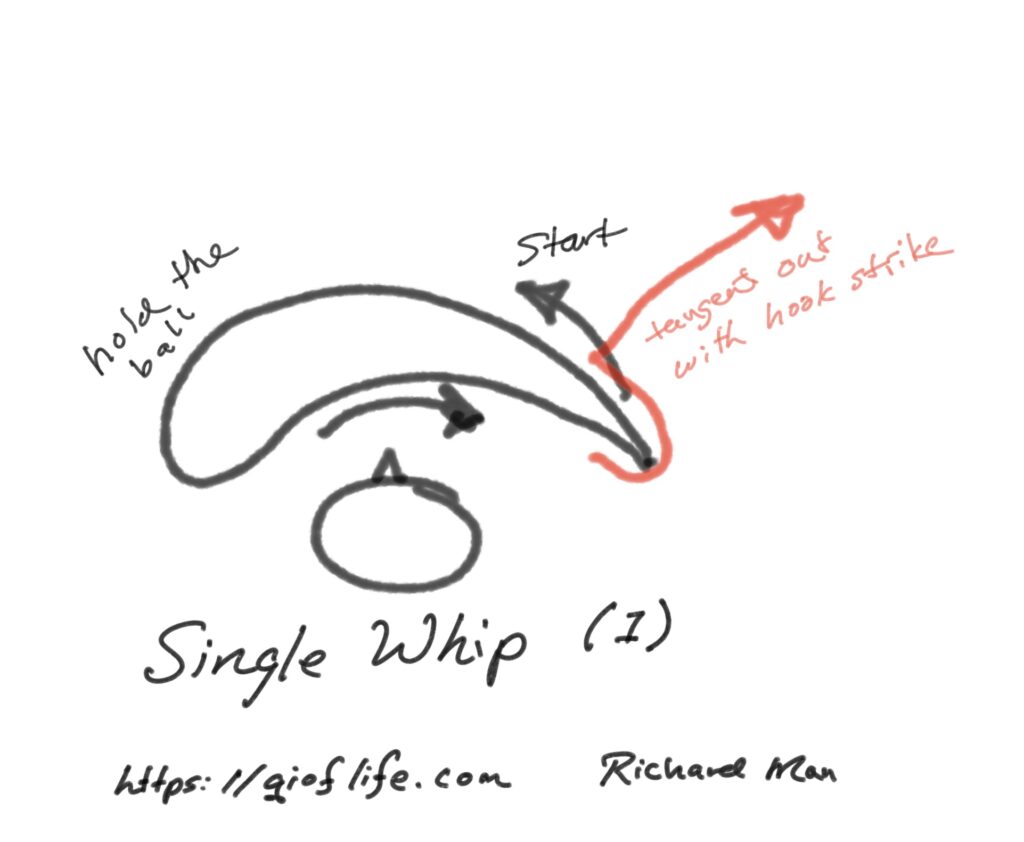
I will write further later, but this is the figure (the Tai Chi fish) I use to describe our form’s Single Whip. It is one of the signature moves of Sifu Sam Tam, with clear application of yielding and back and front strikes.
In the 2020s, while it’s still uncommon, it’s no longer unheard-of to see a Tai Chi “fast form” demonstration, whether it’s a Yang Shaohou or Yang Banhou Fast Form, a Wu Fast Form, or other variations (the Dong / Tung family has a fast form but it was created by the family). What’s particularly interesting about the Wu Fast Form is that it is transmitted only through the Shanghai branch of the Wu style teaching.
To understand why this is interesting, we need to look at the history of Wu style Tai Chi, at least the part that is relevant to this story.
Quan You 全佑 was a Qing dynasty Bannerman of the Yellow Banner group in Beijing. He learned the “Small Circles” and “Large Circles” Tai Chi from Yang Luchan 楊露禪, the founder of Yang style Tai Chi, and his older son, Yang Banhou 楊班侯.
Quan You’s family sinicized their clan name 烏佳哈拉 (Wūjiāhālā) to Wu 吴, and Quan You’s son Wu Jianquan (Wu Chien Chuan) 吴鑑泉 started teaching Wu style Tai Chi in Beijing in the early 1900s.
There is another branch of Wu style mainly taught by the earlier students of Quan You and Wu Jianquan in the Beijing area, which we will not discuss further here.
Wu Jianquan was a contemporary of Yang Luchan’s grandsons Yang Shaohou 楊少侯, and Yang Chengfu 楊澄甫. Wu Jianquan and Yang Chengfu both taught at the Shanghai martial arts association in the 1920s and 1930s.
To popularize Tai Chi to the masses, Yang Chengfu created the large frame form and Wu Jianquan similarly created the large frame Wu style. Yang Chengfu’s form is the most popular Yang form today.
Yang Chengfu had an older brother, Yang Shaohou, who mainly learned from their uncle Yang Banhou. Yang Shaohou did not have many students but was known for his Fast Form and Application Form, both of which were practically unknown in the West until China opened up in the 1980s. Indeed, there are many teachers that claim lineage from Yang Shaohou, but that will take another essay to untangle.
Like many family inheritors, Wu Jianquan’s eldest son Wu Gongyi (Wu Kungyi) 吴公儀 began teaching alongside his father and his brother-in-law Ma Yueliang 馬岳樑 at the Shanghai school in the 1920s and 1930s.
Wu Gongyi went to Hong Kong in 1937 and started the Wu Jianquan school there. He returned to Shanghai in 1942 and moved to Hong Kong permanently in 1949 after the Communist revolution.
Also in 1949, Yang Chengfu’s son Yang Shouzhong (Yeung Sauchung) 楊守中 moved to Hong Kong as well, to Yuen Long, New Territories. In 1952, Dong Yingjie 董英傑 and Wu Gongyi together respectfully invited Yang Shouzhong to take up residence on Lockhart Road on Hong Kong Island.
Let’s take a recap: Yang Chengfu and his brother Yang Shaohou were contemporaries of Wu Jianquan. Wu’s son Wu Gongyi moved to Hong Kong, while his brother-in-law Ma Yueliang and sister Wu Yinghua 吴英華 stayed in Shanghai. Yang Chengfu’s eldest son Yang Shouzhong also moved to Hong Kong at around the same time.
In Hong Kong, Wu Gongyi and his family members were initially known for teaching the Round and Square forms to the public, and the Small Frame Wu Tai Chi to more senior students. In the last years of his life, Wu Gongyi developed the Square Small Frame further into the Quanjit form 關節拳, with precise instructions on how to move and rotate each joint in each movement. This is the form now taught by the Hong Kong Wu Tai Chi Association.
Meanwhile, in the early 1980s, China started to open up, and the martial arts world was stunned by a Wu Fast Form performed by Shi Meilin 施梅林, the adopted daughter of Ma Yueliang and Wu Yinghua. Previously known for the “Shanghai” Wu Round Form and their reputation for excellent Push Hands skills, this until-then little-known aspect of Wu Tai Chi was an eye-opener.
Unlike the slow, even pace of the Shanghai Wu slow form, the Fast Form has Fajin 發勁 and performed at varying speed. This form was practically unheard of in 1982. The Chen style second routine Paochui 炮捶 also has similar characteristics but looks nothing like the Wu style.
At that time there was some speculation about the origin of the Wu Fast Form, but Ma Yueliang was adamant that he had seen Yang Shaohou practicing the same form with Wu Jianquan. Questions arose as to why the Hong Kong Wu branch does not have the form, even though Wu Gongyi was the son of Wu Jianquan and should have inherited all his father’s skills. Moreover, it was noted that both Wu Gongyi and his brother Wu Gongzao 吳公藻 also learned directly from Yang Shaohou as well. Multiple sources have also confirmed that the Wu Fast Form is essentially the same as (one of) the Yang Shaohou Fast Forms.
So to reconcile how two branches of the same martial family settled on two different advanced forms, there can be several possibilities. After studying Tai Chi for a few decades now, and having been exposed to several systems, with my primary learning from Sifu Sam Tam, my opinion is that the respective masters emphasized different paths to mastery. This is of course only my humble opinion, as I have not personally experienced the Quanjit form, and have only a small understanding of the Wu Fast Form. However, a common saying is that there are many paths to the mountain top. Both forms embody the principles of Tai Chi, and it is very instructive to trace the origin and history of these two forms.
For reference:
Shi Meilin performing the Wu Fast Form:
Eddie Wu 吳光宇 (grandson of Wu Gongyi) performing 108 Quanjit Form
I read a Tai Chi practitioner saying that they want to teach at a community center but weren’t quite sure what to teach, as the 24 form is too simple, that it feels like just “waving the arms”.
First of all, it’s true that the Simplified 24 form was created in China in the 80s by some sports committee to make Yang Tai Chi easier to learn – a bit of precursor to the “Wushu Tai Chi” if you will.
However, Tai Chi is about the Principles. It’s an Internal Martial Arts for a reason (and yes, I know Sun Lutang and others coined the terms only relatively recent, in the late 1800s and early 1900s). That is, it doesn’t matter you are doing one move, 24 form, 37 form, 108 form, or even just a static Standing Meditation – all the internals must be there.
Tai Chi is not about the external moves, it’s not about application, it’s about making a Tai Chi body that makes manifesting the applications possible.
This is the Taoist principle of wu wei (無為) of accomplishing by aligning with the natural flow, the path of least resistance.